Above the couch
Gallery wall above the couch — sizing, spacing, and 5 layouts that work.
By Ömer İlhan · Updated May 6, 2026 · 9 min read
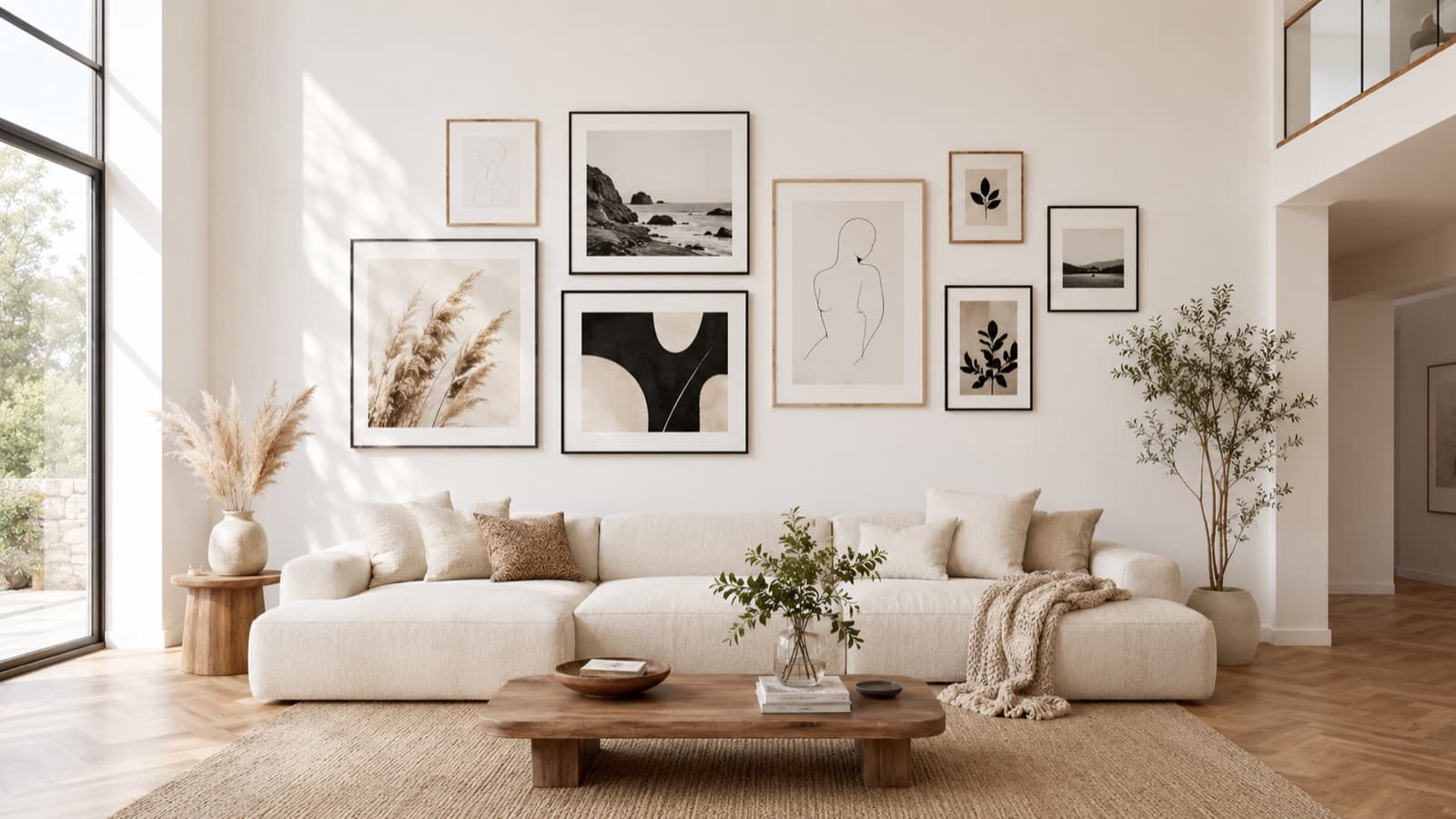
The wall above a couch is the highest-stakes wall in most living rooms. It's the first thing a guest sees, the backdrop of every couch photo, and — because it sits at exactly the height that magnifies mistakes — also the wall most likely to feel wrong even after you've hung something. The fix is almost always sizing or clearance, not the art itself. Here is the short version of what works and the longer version of why.
The two-thirds rule (and the rare exceptions)
The total width of the gallery should sit between two-thirds and three-quarters of the couch's width. A 220 cm couch wants a gallery roughly 145–165 cm wide. Going wider than the couch reads chaotic; going narrower than two-thirds reads timid, like the wall is wearing a too-small hat.
The exception is the spotlight layout: a single oversized piece (typically 90–110 cm wide for a 220 cm couch) deliberately centered with breathing room on both sides. The negative space does the same job that fill pieces would do in a wider gallery — it frames the composition.
Bottom-edge clearance is the silent killer
The lowest frame in the gallery should sit 20–25 cm above the top of the couch back. Closer than 20 cm and the gallery looks like it's resting on the couch (and gets bumped every time someone sits down). Higher than 25 cm and the gallery and the couch feel like strangers — visually disconnected, like two unrelated room features.
Measure from the top of the couch back, not the cushions. If your couch has a low or sloping back, raise the clearance to 25–30 cm so the gallery doesn't feel like it's hovering at lap level.
Forget eye level — couches change the rule
The standard 145–155 cm-from-floor gallery eye-level rule assumes a piece hung on an unobstructed wall. A couch raises that rule. Once you set the bottom edge of the lowest frame at 20–25 cm above the couch back, the eye-level rule is already taken care of — the gallery's vertical center lands at roughly 165–180 cm, which reads correct because the viewer's eye orients to the couch first, then drifts up.
Trying to enforce a 145 cm-from-floor rule above a couch is what produces the floating-mid-air look. Trust the couch-relative measurement, not the floor-relative one.
Five layouts that work above a couch
These are the five compositions we keep returning to. All assume a 200–230 cm couch, which is the most common three-seater range. Scale up or down proportionally for a wider sectional or a narrower loveseat.
01 — Tight grid (3×2)
Six identical 28×36 cm frames in two rows of three.
Calm, modern, very forgiving. Use a 5 cm gap between every frame. The whole composition spans about 100 cm wide and 80 cm tall — sized for a 160 cm couch. Scale frames to 30×40 cm for a 200+ cm couch.
02 — Asymmetric anchor
One 60×80 cm anchor, two 30×40 cm satellites stacked beside it.
The anchor sits to the left, slightly below center; the satellites stack vertically to the right with a 5 cm gap between them and 8 cm between the stack and the anchor. Reads dynamic, intentional, works in awkward bays.
03 — Salon-style cluster (7 pieces)
One 50×70 anchor, two 40×50, two 30×40, two 20×25 — packed.
Tightest spacing in the cluster (3 cm gaps). Anchor offset slightly left of center. Smaller pieces fill the perimeter. Asymmetry is deliberate — perfect symmetry kills the salon feel.
04 — Spotlight (single oversized piece)
One 100×140 cm piece, centered, with deliberate negative space.
The cheapest layout if the piece carries weight. Works best with a strong photograph, abstract, or vintage poster. Sits at 30 cm above the couch back to maintain visual presence without dominating the room.
05 — Horizontal triptych
Three landscape-oriented 40×30 cm prints in a row.
A 5 cm gap between each frame. Total span ~140 cm — fits a 180–200 cm couch perfectly. The horizontal orientation echoes the couch line and reads calm, almost architectural.
Frame size combinations that compose well
The fastest way to make any of the layouts above feel considered is to pull frame sizes from a single ladder rather than improvising. Two safe ladders:
- Metric ladder: 20×25, 30×40, 40×50, 50×70, 60×80 cm. Pick three sizes from this list for any multi-piece layout.
- Imperial ladder: 8×10, 11×14, 16×20, 18×24, 24×36 inches. Same logic.
Mix portrait and landscape orientations within the same layout — at least one of each — to break up the rhythm. A wall of only portraits feels like a corridor; only landscapes feels like a panoramic billboard.
Mock the layout before you commit
The cost of getting it wrong above a couch is high — drywall holes are visible, and rehanging usually means a fresh round of touch-up paint. Use one of two mock-up methods before you drive a single nail.
Paper templates: cut kraft paper to the exact dimensions of each frame, tape them to the wall with painter's tape, live with the composition for a day. Cheap, slow, accurate.
Digital planner: use a tool that previews frames at real wall scale on your screen. Ours is free and runs entirely in your browser — drop the couch dimensions in, drag your prints into place, and export the layout. Faster than paper for any composition with more than three frames.
Frequently asked
- How wide should a gallery wall be above a couch?
- Aim for two-thirds to three-quarters of the couch width. A 220 cm couch wants a gallery roughly 145–165 cm wide. Going wider reads cluttered; going narrower than two-thirds reads timid, like the wall is wearing a too-small hat. The exception is the spotlight layout — a single oversized piece centered with deliberate negative space on both sides.
- How high should I hang art above a couch?
- The bottom edge of the lowest frame should sit 20–25 cm above the top of the couch back. Closer than 20 cm and the gallery looks like it's resting on the couch; higher than 25 cm and the gallery and couch feel visually disconnected. Measure from the top of the couch back, not the cushions.
- What's the best frame size combination above a couch?
- Pull two or three sizes from a single ladder — either metric (20×25, 30×40, 40×50, 50×70, 60×80 cm) or imperial (8×10, 11×14, 16×20, 18×24, 24×36 in). Mix portrait and landscape orientations within the same layout to break up the rhythm. A wall of only portraits feels like a corridor; only landscapes feels like a panoramic billboard.
- Can a gallery wall be wider than the couch?
- Generally no. A gallery wider than the couch reads as visual overflow — the eye finds the gallery edge before it finds the composition. The exception is sectionals or banquettes where the seating extends beyond a typical couch footprint, in which case match the gallery to the seating's full width.
- Should I center the gallery on the couch or on the wall?
- Center on the couch, not the wall. The couch is the visual anchor of the room; the wall is just the surface behind it. If your couch sits off-center against the wall (because of a window or door constraint), the gallery follows the couch.
- How much spacing should I leave between frames above a couch?
- 5 cm (2 in) gaps between every pair of frames is the default sweet spot. Tighter (3 cm) reads as one composition — good for salon-style. Wider (8 cm or more) reads as separate pieces sharing a wall — fine for spotlight, wrong for a grid. Whatever you pick, hold it across every gap. Inconsistency is what readers notice.
Plan your above-the-couch wall on screen.
Set the wall to your couch's width, drag prints into place, frame them, and see the composition at real centimeters before you touch a nail. Free, no signup.
Open the gallery wall designerKeep planning
Published 2026-05-06. Updated 2026-05-06.