Staircase
Staircase gallery wall — slope math, spacing, and ascending layouts.
By Ömer İlhan · Updated May 6, 2026 · 10 min read
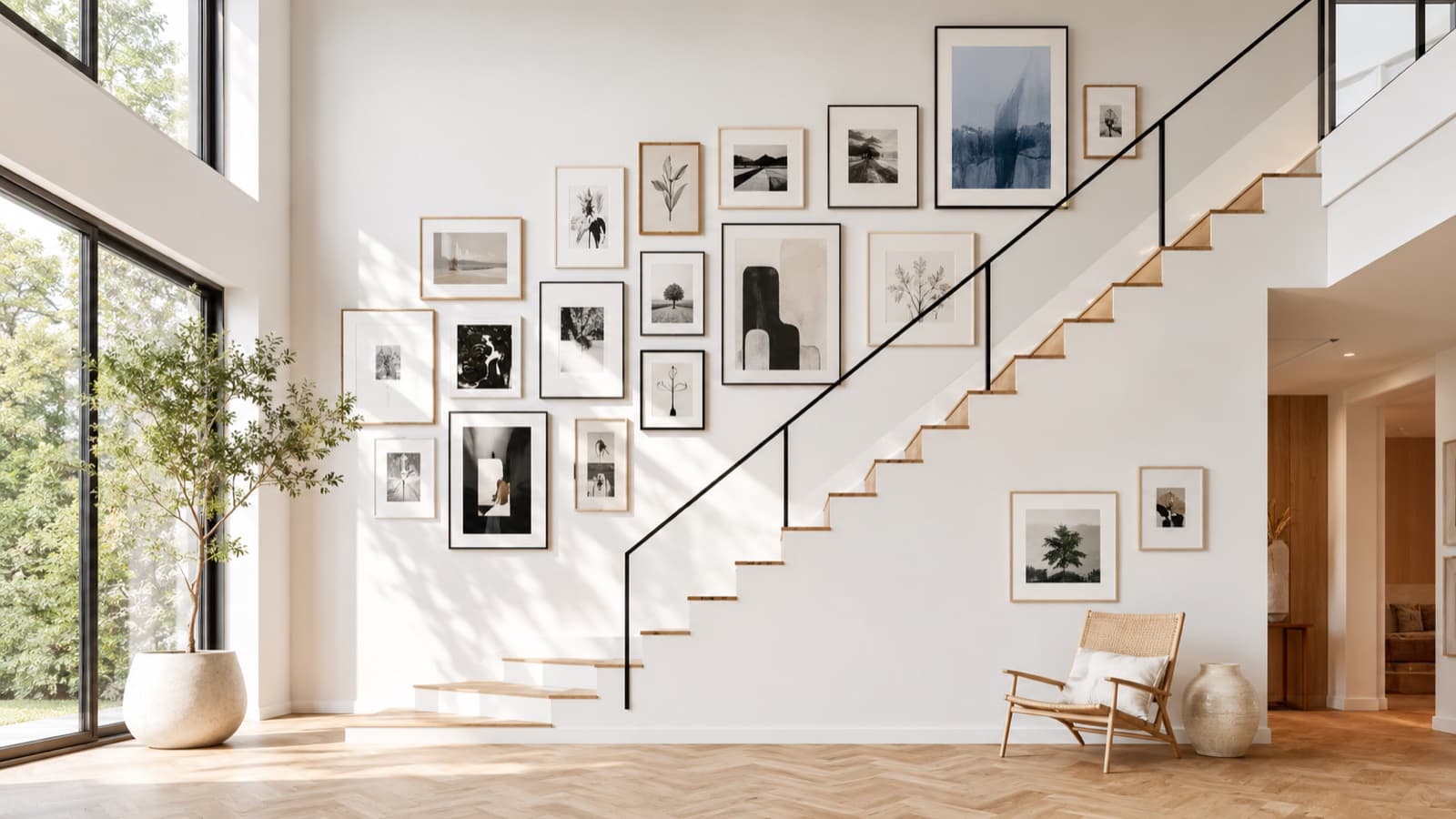
A staircase gallery wall fights every rule the rest of the house follows. There is no flat floor below it, the eye level changes with every step, and the wall itself is usually long, skinny, and visible from two rooms at once. Get the geometry right and it becomes the most photogenic wall in the home. Get the geometry wrong and the frames look like they're sliding down the stairs. The trick is one piece of math, two non-negotiables, and a little patience with painter's tape.
The one piece of math: stair rise over run
Every staircase has a slope, defined by the rise (vertical height of one step) over the run (horizontal depth of one step). For most US residential stairs, that's roughly 18–20 cm of rise over 25–28 cm of run — a slope of about 35–40 degrees from horizontal.
That slope is the line your gallery wall has to follow. Don't try to hang frames horizontally up a staircase — they'll fight the architecture. The frame centers should rise step-by-step at the same angle as the stairs themselves.
Practical version: measure the rise and run on three steps, divide rise by run, and you have your slope ratio. A common example is 18 ÷ 28 = 0.64. Every horizontal centimeter of wall, your frame centers should climb 0.64 cm vertically. That's your line.
Forget eye level — use per-step eye level
The 145–155 cm-from-floor rule that governs flat-wall gallery hanging breaks down on a staircase, because there is no single floor. The fix: each frame center sits roughly 145 cm above the tread directly below it.
In practice this means as you climb the stairs, you stand at a constant relative height to each frame as you pass it. The composition reads correctly from inside the staircase, where you'll spend most of your time looking at it.
The exception is two-story landings — flat sections that interrupt the stairs. Treat each landing as its own flat-wall segment with the standard 145–155 cm-from-floor rule. The slope rule resumes at the next step.
Consistent center-to-center spacing
On a flat wall you can get away with eyeballing spacing between frames. On a staircase you can't — the slope amplifies any inconsistency, because every frame either looks aligned to the slope or it doesn't.
The rule: measure the horizontal distance between frame centers (not edges), and keep it constant. A common workable spacing is 35–40 cm horizontal between adjacent frame centers. The vertical offset takes care of itself, because each adjacent frame center sits on the same slope line.
Edge-to-edge spacing is what fails on staircases. Frames of different sizes have different edges; their centers are the only consistent reference. Use a tape measure across the wall horizontally between centers, not diagonally between corners.
Four ascending layouts that work
These four are the staircase compositions we keep using. They span 6–10 stairs and assume a wall depth of about 70–90 cm available alongside the staircase.
01 — Single line, identical sizes
Six 28×36 cm portraits, all identical, climbing the slope at 35 cm horizontal spacing.
The simplest, calmest staircase gallery. Reads architectural, almost like a printed handrail. Best for photography series, botanical prints, or a single artist's prints. Most forgiving of measurement errors.
02 — Single line, mixed sizes
Five frames alternating between 30×40 and 40×50 cm, all centers on the same slope line.
More dynamic than identical sizes. The size variation creates rhythm; the shared slope line keeps it ordered. Place the larger sizes at the climb and descent ends; smaller ones in the middle.
03 — Two-line stagger
A primary line of larger frames, a parallel secondary line of smaller frames offset 30 cm above.
For taller staircase walls. The two lines create a band that follows the slope, doubling the visual weight without making any single frame larger. Keep both slope lines parallel — they should rise at the same rate.
04 — Cluster at the landing, line on the climb
A salon-style cluster of 5–7 frames on the landing wall, transitioning into a single ascending line.
Best for staircases with a generous landing wall. The cluster gives the eye a destination at the top; the line draws the viewer up. The transition between cluster and line should sit at the start of the steps, not mid-climb.
Avoid the stair-stepped frame cliché
There is a mistake every staircase gallery tutorial seems to propagate: frames hung in literal stair-step shapes, where each frame sits a fixed vertical and horizontal offset from the next, mimicking the steps below. It looks intentional in a sketch and clumsy on a wall.
The fix is to follow the slope of the stairs, not the steps. Frame centers should sit on a smooth diagonal line — continuous, not stepped. The architecture below already steps; the wall above doesn't need to.
Test on the wall first — twice
Staircase gallery walls are the hardest gallery walls to rehang, because nail holes on a sloped wall are visible from multiple angles and a misjudged spacing means visible holes between every pair of frames. Mock the layout twice before committing.
Painter's tape: stretch a long piece of low-tack painter's tape along the slope line at frame-center height. Mark each frame center on the tape. Check the line from the bottom of the stairs and from the top — both views matter.
Digital planner: use a tool that lets you preview the layout at real wall scale. Ours is free — drop in the wall dimensions, drag your prints onto the slope line, and export the spacing measurements before you touch a hammer.
Then live with the painter's-tape mock-up overnight. Walk up and down the stairs a few times. Anything that looks wrong will reveal itself before drywall is involved.
Frequently asked
- How do I hang frames on a sloped staircase wall?
- Frame centers should follow the slope of the stairs, not horizontal lines. Measure the rise and run of three steps, divide rise by run to get your slope ratio (commonly around 0.64), and use that ratio to plot every frame center on a single diagonal line. Don't try to hang frames horizontally up a staircase — they fight the architecture.
- What spacing should I use between staircase gallery frames?
- Measure the horizontal distance between frame centers — not edges — and keep it constant. A common workable spacing is 35–40 cm horizontal between adjacent frame centers. The vertical offset takes care of itself because each adjacent frame center sits on the same slope line.
- Should staircase gallery frames be the same size?
- Either works. Identical sizes (a single repeated frame size like 28×36 cm) read calm and architectural. Mixed sizes (alternating between 30×40 and 40×50 cm) read more dynamic. The shared slope line keeps mixed sizes ordered. Place larger sizes at the climb and descent ends; smaller ones in the middle.
- How high should each frame sit on a staircase?
- Each frame center sits roughly 145 cm above the tread directly below it. The 145–155 cm-from-floor rule that governs flat-wall hanging breaks down on a staircase because there's no single floor. Per-step eye level keeps the composition reading correctly from inside the staircase.
- What's the stair-stepped frame anti-pattern?
- Frames hung in literal stair-step shapes — each frame sitting at a fixed vertical and horizontal offset from the next, mimicking the steps below. It looks intentional in a sketch and clumsy on a wall. Follow the slope of the stairs, not the steps. Frame centers should sit on a smooth diagonal line, continuous, not stepped.
- Can I mix frame sizes on a staircase wall?
- Yes — and it often reads more dynamic than identical sizes. The rule is to keep all frame centers on the same slope line. Two safe approaches: alternate between two sizes (30×40 and 40×50 cm) at consistent spacing, or place a salon-style cluster on the landing wall and a single ascending line on the climb.
Plan your staircase gallery on screen.
Set the wall dimensions, drag prints onto the slope line, preview at real centimeters, and export the spacing measurements. Free, no signup, runs entirely in your browser.
Open the gallery wall designerKeep planning
Published 2026-05-06. Updated 2026-05-06.