Vintage style
Vintage gallery wall — frame mixing, mat depth, and a 6-piece starter mood.
By Ömer İlhan · Updated May 6, 2026 · 9 min read
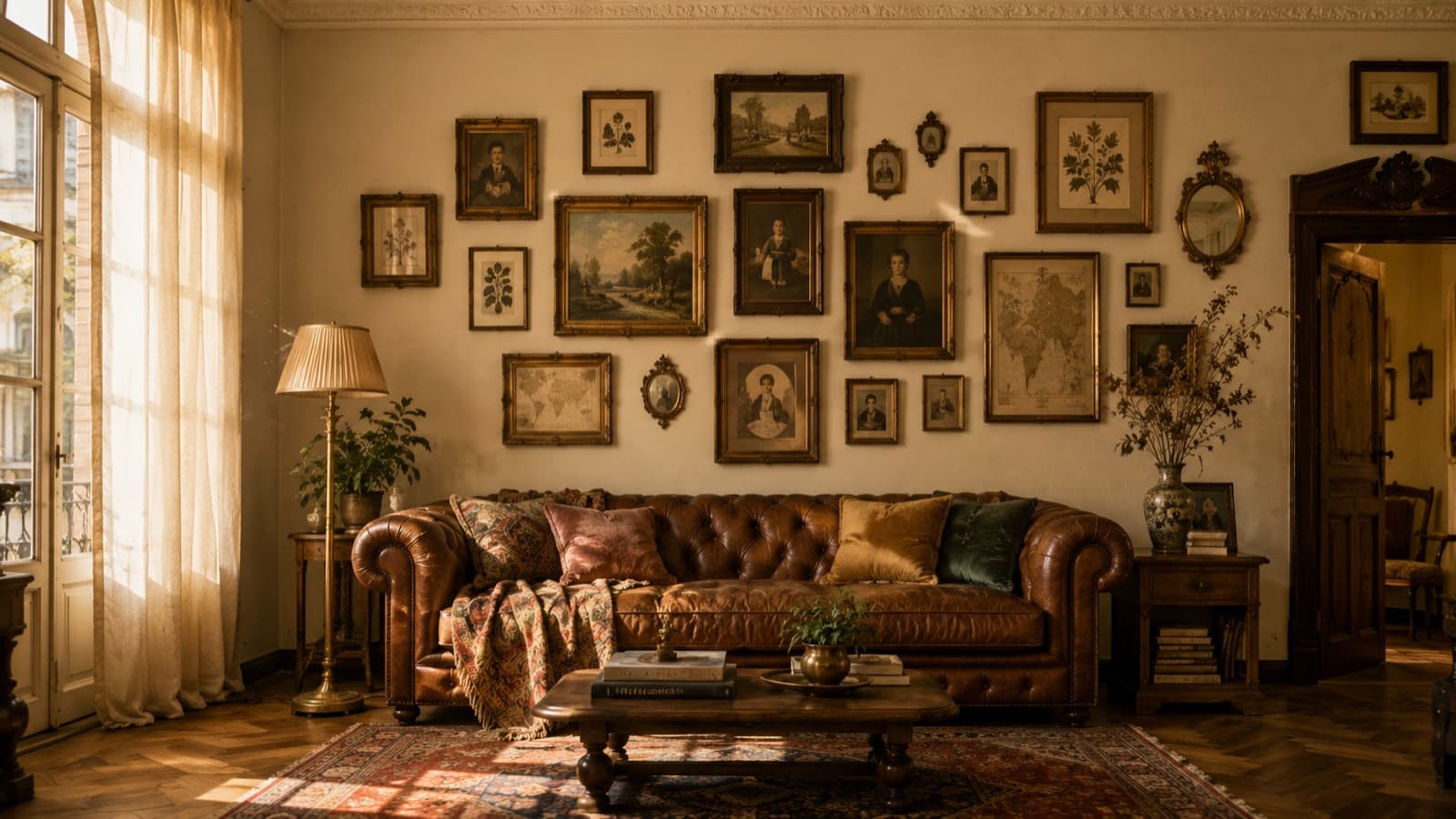
A vintage gallery wall is the easiest style to want and the hardest style to execute. The reference photos on Pinterest all show clusters of mismatched gilded frames, faded botanicals, and dusty oils — beautiful, casually composed, and apparently effortless. They are not effortless. There is real geometry and a small set of unifying decisions hiding under the casual look. Get those right and a vintage gallery wall comes together in an afternoon. Skip them and you end up with a thrift-store wall that just looks confused.
What actually reads as vintage
Three signals do most of the work, in order of importance: frame finish, mat treatment, and color story.
- Frame finish: warm metallics (antique gold, burnished brass, aged brown), distressed wood, or chipped paint. Modern matte-black or chrome frames break the spell instantly.
- Mat treatment: off-white, cream, or warm beige mats — never bright white. Mat depth is generous (5–8 cm), which signals craft and age.
- Color story: warm neutrals, muted golds, faded sepia, dusty greens, burgundy, navy. Saturated primaries and cool blues read contemporary and break the mood.
If your reference image looks vintage but you can't place why, look at those three first.
Frame mixing rules — three finishes, no more
The defining mistake people make with vintage gallery walls is collecting too many frame finishes. The wall reads as noise instead of as a curated collection. The fix is a hard limit: three finishes maximum across the entire composition.
A workable trio:
- Antique gold (gilded): the dominant finish, used on the largest pieces. Carries the room.
- Distressed dark wood: the supporting finish, used on medium pieces. Grounds the gold.
- Off-white painted (chipped): the accent finish, used on the smallest pieces. Lifts the composition and breaks up density.
Roughly 50% of the frames carry the dominant finish, 30% the supporting, and 20% the accent. Hold this ratio even as you swap individual pieces.
Within each finish, mix profiles freely — ornate carved gilt next to flat gilt, plain dark wood next to deeply molded dark wood. Variety inside one finish reads as a collection; variety across finishes reads as chaos.
Mat depth as the unifier
The single fastest way to make a vintage gallery wall cohere is to give every framed piece a deep mat — 5–8 cm wide, in off-white or warm cream. The mat does three things at once.
- Visually expands smaller pieces so they hold their own next to the anchors.
- Creates a continuous off-white border around every piece, which the eye reads as a unifying element across mismatched frames.
- Signals craft. Deep mats are expensive and time-consuming in real life, so the eye reads them as “this was curated.”
Use the same mat color across every framed piece. Variation in mat color across the wall defeats the unifying effect entirely.
Color story — warm and faded, not bright
The color palette is the third leg. Vintage prints, photographs, and oils all share a faded, slightly warm quality — the kind of color shift that a hundred years of light exposure produces naturally. Modern prints in vintage frames break the mood unless the color palette cooperates.
The palette to stay inside:
- Warm neutrals: cream, ivory, oat, bone.
- Muted metals: dull gold, brass, copper, bronze.
- Faded sepia and warm browns.
- Dusty greens, faded burgundy, muted navy, soft terracotta.
Avoid: pure black, pure white, electric blue, hot pink, any high-saturation color. One warning sign: if the palette would look at home in a 1970s color sample card, you're in the right place. If it would look at home in a 2020s phone case, you're not.
Where to source vintage frames
Authentic vintage frames come from four reliable sources, roughly in order of cost.
- Estate sales: the cheapest source. You buy frames as a lot, get most of what you need at one stop, and walk away with a story for each frame.
- Thrift stores: patient hunting required. Look for ornate gilt frames hung high or in the housewares back-corner. Most are $5–20.
- Antique malls: curated, marked up, faster. Expect $25–80 per frame depending on the booth.
- Etsy / eBay: the slowest but most predictable. Filter by “antique picture frame” and sort by lowest price. Shipping is the tax.
If the vintage hunt isn't your hobby, IKEA's Knoppäng line in dark wood plus a few thrift-store gilt frames will pass for a vintage wall at half the cost and a tenth of the time.
A 6-piece starter mood
Here is a specific six-piece composition we keep recommending as a first vintage gallery wall. Total span ~120 cm wide × 90 cm tall. Works above a console table or a low credenza, or as the right half of a salon-style cluster.
01 — Anchor
40×50 cm framed botanical print, antique gold ornate frame, 7 cm cream mat.
Centered slightly low-left in the composition. Carries the visual weight.
02 — Secondary
30×40 cm vintage map (faded sepia), distressed dark wood frame, 5 cm cream mat.
Upper right of the anchor. Different finish, similar color story.
03 — Secondary
30×40 cm faded portrait or figure study, antique gold flat frame, 5 cm cream mat.
Upper left, balancing the map. Same finish family as the anchor, simpler profile.
04 — Filler
20×25 cm pressed flower or botanical detail, off-white painted frame (chipped), 4 cm cream mat.
Lower right. The accent finish enters here.
05 — Filler
20×25 cm vintage postcard or illustration, antique gold thin frame, 4 cm cream mat.
Lower left. Returns to the dominant finish to ground the bottom edge.
06 — Filler
15×20 cm ornament — small framed mirror, oval gilt frame, no mat.
Tucked into the composition, breaks the rectangular rhythm. Mirror catches room light, adds depth.
Mock it before you commit
Vintage gallery walls reward patience and punish guesses. Frame profiles are heavier than modern frames, mat depths vary, and the composition takes time to settle. Mock the whole layout at scale — paper templates on the wall, or a digital planner that previews at real centimeters — before you commit to nail holes.
Our free designer lets you set the wall dimensions, drag every framed piece into place, and adjust frame and mat width per piece. It runs entirely in your browser, no signup, and we built it because mocking up a six-frame vintage cluster on paper takes a full afternoon.
Frequently asked
- What frames make a gallery wall look vintage?
- Three frame finishes carry the vintage signal: warm metallics (antique gold, burnished brass, aged brown), distressed wood, and chipped paint. Modern matte-black or chrome frames break the spell instantly. Mat treatment matters too — off-white, cream, or warm beige mats with generous depth (5–8 cm) signal craft and age the way bright white mats can't.
- How do I mix vintage frame finishes without it looking chaotic?
- Hold to three finishes maximum across the entire wall: a dominant finish on roughly 50% of pieces (typically antique gold), a supporting finish on 30% (distressed dark wood), and an accent finish on 20% (off-white painted, often chipped). Within each finish, mix profiles freely — ornate carved gilt next to flat gilt, plain dark wood next to deeply molded dark wood. Variety inside one finish reads as a collection; variety across finishes reads as chaos.
- What mat color should I use for a vintage gallery wall?
- Off-white, cream, or warm beige — never bright white. The same color across every framed piece. Mat depth should be generous (5–8 cm), which signals craft and age. The continuous off-white border the eye sees around every piece is what unifies a wall of mismatched frames into one composition.
- Where can I source authentic vintage frames?
- Estate sales are the cheapest source — you buy frames as a lot and walk away with most of what you need at one stop. Thrift stores require patience but yield $5–20 ornate gilt frames. Antique malls are curated and marked up ($25–80 per frame). Etsy and eBay are slowest but most predictable. If the hunt isn't your hobby, IKEA's Knoppäng line in dark wood plus a few thrift-store gilt frames will pass for vintage at half the cost.
- How many vintage frames make a gallery wall?
- Six is the sweet spot for a starter vintage cluster. One large anchor (40×50 cm), two medium secondaries (30×40), and three small fillers (15–25 cm) give enough variety to feel composed without overwhelming the wall. Anything over ten pieces requires confidence and a deliberate salon-style approach.
- Can I mix vintage and modern art in a vintage gallery wall?
- Yes, as long as the color palette stays warm and faded. The frames carry the vintage signal; the art inside them can be modern. The constraint is palette: warm neutrals, muted golds, dusty greens, faded sepia, soft burgundy. Saturated primaries and electric blues read contemporary and break the vintage mood, regardless of what frame they sit in.
Plan your vintage cluster on screen.
Set the wall dimensions, drag each framed piece into place, set frame width and mat depth per piece, and preview at real centimeters before you commit.
Open the gallery wall designerKeep planning
Published 2026-05-06. Updated 2026-05-06.